
TEARS, TOOLS and TREASURE by Cindy Eastman
A New Collaboration Featuring Bereaved Parents


Thank you so much to Cindy for being a guest contributor to this new collaboration.
Each post is written by a bereaved parent, responding to the same three questions. My hope is that, in reflecting on their own journey and describing what has been the toughest part of losing a precious child, as well as the things that have supported them in this profound grief, their words will help other parents who also know this loss. And finally, I hope that stories of unexpected gifts that have come, even amidst the pain, will reflect the potential for joy returning into the darkest places as we all travel this path, together.
It’s my pleasure to introduce Annie
How to describe my daughter Annie? First of all, she was my North Star. After she died, I heard over and over how she made people feel so comfortable, so seen, so loved. She had an interest in everyone she met and when she took on a task—a job, a hobby, a volunteer commitment—she gave it 1,000 %. When she got her diagnosis of Stage 2 Triple Negative breast cancer, she left no stone unturned in looking for ways to fight it and live with it, while continuing to take care of her family and friends. She once told me that there’s no reason she couldn’t be a miracle. Of course, to me, she already was.
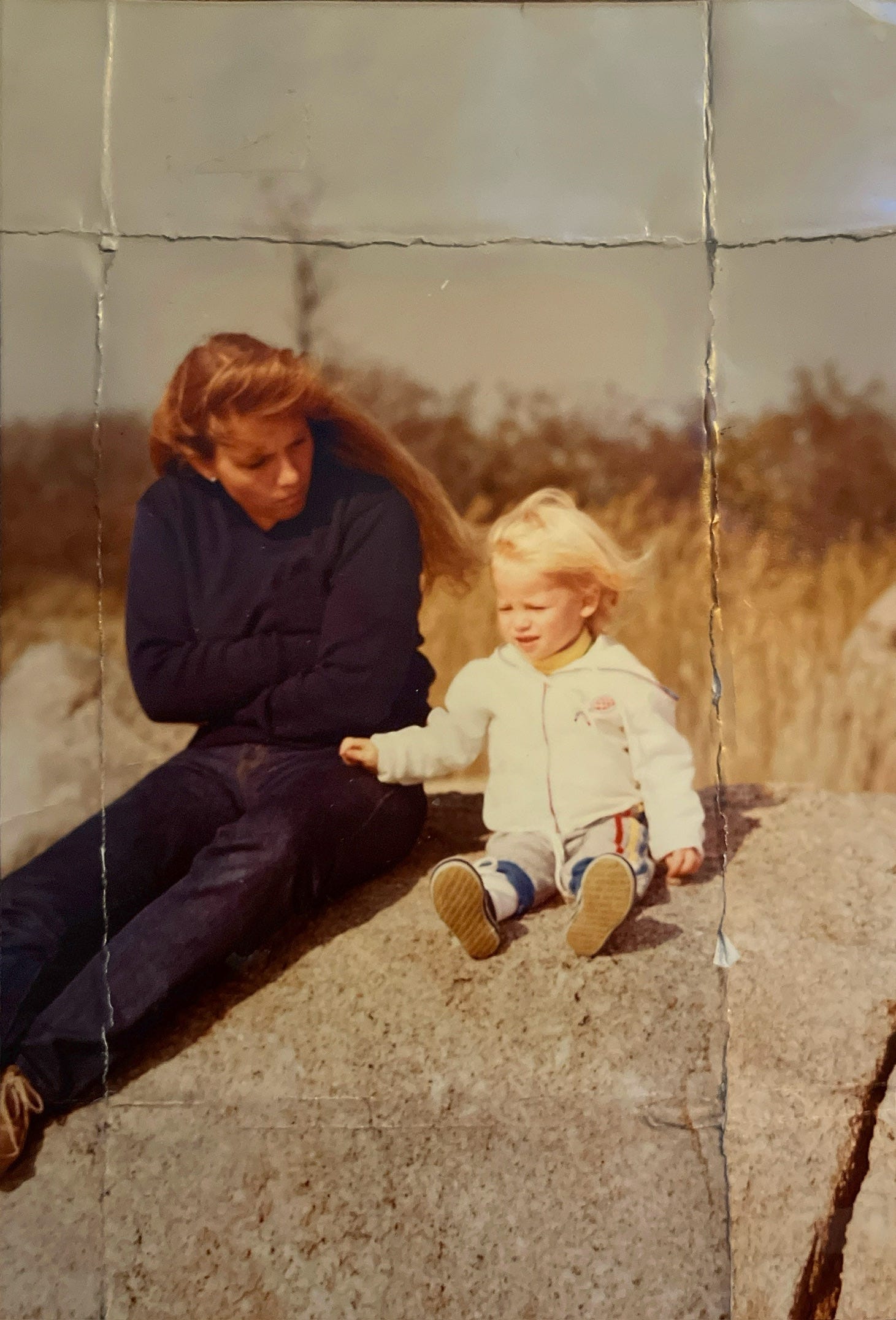
Me and Annie, as a little girl
This is the first photo of us I sought out the night she died. It was folded up in a frame and I took it out and taped it to the wall above my desk, where it remains. I love this one so much. She looks like she’s explaining something that I desperately needed to know.
TEARS…what has been the saddest, hardest and/or worst part of losing your daughter?
Parents who have lost children know there is no one saddest or worst part, but the one I decided to share in this instance is handling the grief of Annie’s other loved ones, and most specifically, her son. He was just about 10 years old when she was diagnosed and only 12 when she died. Knowing how to be present for him as he continues to grow and develop and navigate his own grief is one of the hardest things I feel I have to do. For example, I know how I feel…I have days where I just want to cry all day or sink into sadness. I miss the past, present and future of Annie, but that’s me. Those are my feelings. I can’t put my grief onto her son because he understands it and deals with it in so many different ways.
Ever since Luca was born, his dad has travelled weekly for work. While he was a wonderful parent when he was home, for most days of the week Annie was the parent in charge, which meant she and Luca were very close. If she was my North star, Luca was Annie’s and you could see how much they loved each other instantly.
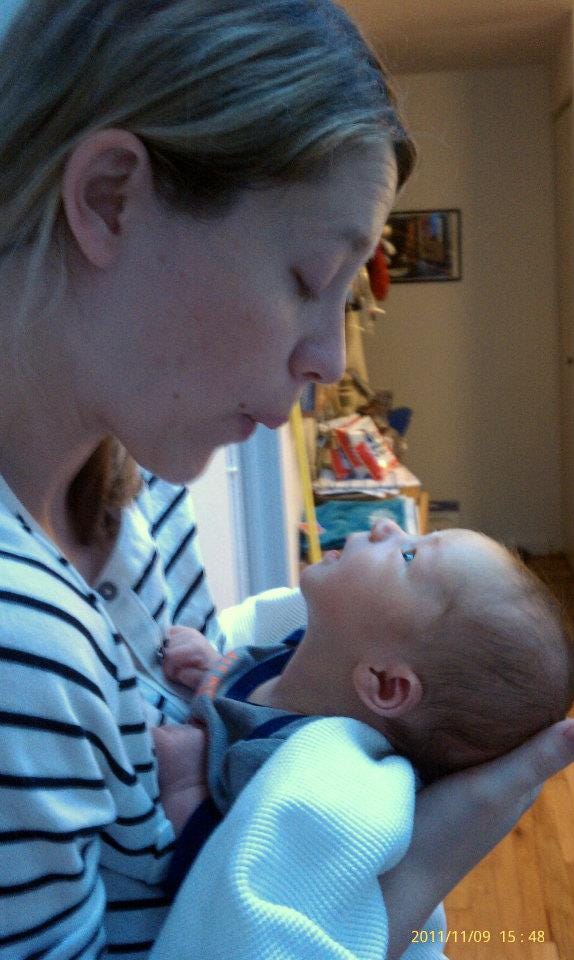
Annie and Luca. They are entranced with each other
It is because of this closeness that I have been like a hawk watching for any signs of difficulty or distress in the way Luca is handling his grief. Since his dad continues to travel, I am with Luca almost every week. I am grateful to have such an opportunity, and spend so much time with him, but sometimes I catch myself assigning grief to his behavior or reactions if he’s being moody or emotional. But he’s also a now 14-year-old boy and he could be going through a dozen other reasons for his acting out or moodiness. I have to be careful to watch myself, even as I also grieve for the reality that Annie should be here helping him to navigate his development and teenage years. Although, I have to add, he’s an amazing child and can teach me a few things about grieving as well.
TOOLS…what have you found most helpful in navigating your tragedy?
Writing has always been the way I make meaning out of my lived experiences. At some point—and I don’t recall whose idea this was—but Annie and I decided to write a series of articles about our experience. We called it “Can We Talk About Cancer?” and each article was a conversation between us about the issues that came up in dealing with the diagnosis, the treatment, and just being a mom and a daughter who had to navigate it all. I was actually surprised she agreed to it, because she was typically a very private person. But she was also a brilliant writer and I am so grateful now that I have those conversations between us to go back to.
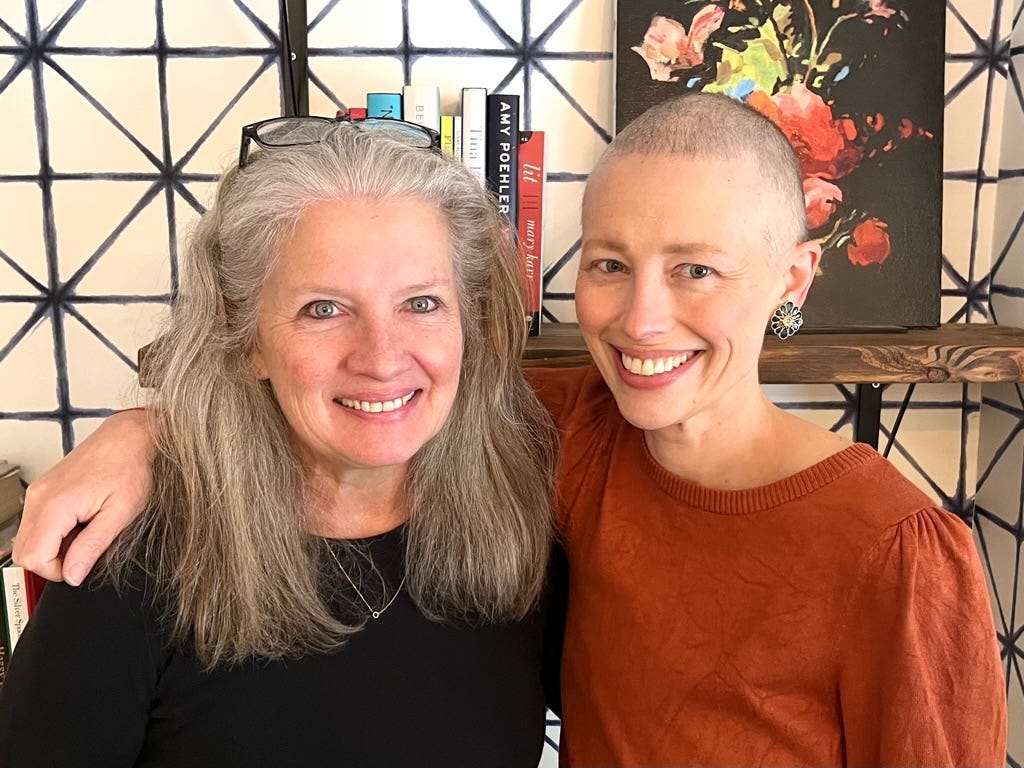
Our headshots for the article
I can also be a very private person, contrary to the fact that I write openly about my life in books and weekly essays! I relish my time alone in my home and I’ve always been a bit of a homebody anyway and losing Annie has put an emphasis on that. But, even though I don’t seek out company, it is the company I have in my life that is the net under this tightwire of grief I walk. For at least a year, and in many ways still, a number of Annie’s friends practically held my hand on a daily basis, checking in with me, steadying me, keeping in touch. They were also responsible for helping to make Annie’s celebration of life a beautiful and memorable experience for all who attended and some of them have stayed on to help with creating a nonprofit in her honor. We are trying to keep the ideals Annie was so passionate about going, which are kindness, community and conservation.
And of course my family and close friends. The outpouring of love and support I received and continue to receive is the gift I didn’t know I needed. A strong current of love buoys me and it never ceases to amaze me that so many people are still there for me, when I know others can tend to fade away after a tragedy. That is not to say I don’t have rough times, because I do. I don’t know how other parents get through it and I’m sad to say I personally know some of those parents. And I guess, in an ironic way, knowing other parents, sharing their stories—as in collaborations like this one—allow me to know that as horrible and tragic and individual my loss is, I’m not the only one.
TREASURE…what have you, maybe unexpectedly, discovered that has brought you joy as you’ve walked this path?
The love I mentioned already is a constant source of smiles and warmth and support. But I suppose the one thing that I can actually say brings me joy are my grandchildren. Annie’s son of course and my other three are a source of delight and pride and laughter. I am lucky to spend a lot of time with the two of them who live nearby in Connecticut. The other two live in Arizona—too far to drive over and hang out with unfortunately, but we try and stay in touch and visit when we can.
And the other thing that was unexpected--and maybe not joyous--but it makes me feel good about myself is that I am still able to experience gratitude. I know that it might sound silly to be happy over such a simple thing, but this is a path that I was forced to navigate and I can easily see how people can become angry and isolated with having to deal with such unfairness and heartbreak. In all the ways that parents can lose a child are all the ways that it can be relentless and challenging to simply get up each day and move forward. Because of the kind of support I have from my family and friends and through the work I do teaching writing groups and workshops, I find many opportunities to be grateful. I feel lucky that way.
Find Cindy on Substack at Silver Linings. Her website is cindyeastman.com
The non-profit in Annie’s name is Pocket Full of Rocks. I asked Cindy to give a little more information about this and her words are below:
We’ve called it Pocket Full of Rocks, which was going to be the name of the memoir she had begun after she was diagnosed (and which I plan to finish for her). In the last year and a half since we started it, we’ve sent out gift cards to several cancer patients, given a scholarship to a summer arts camp and two additional high school scholarships in Annie’s name at her alma mater.
And finally, Cindy’s question for me
This question was put to me when I was editing an anthology about grief. There were over 70 submissions of essays and poetry describing all the ways the writers had experienced grief and loss. The question is: How are you able to read so many stories about grief? What kind of impact does it have on you?
Thanks for this question, Cindy. In answering it, I’d like to quote something you said in your own piece here which really resonated for me, and perhaps describes best why reading the stories of other parents’ grief, moving as each and everyone is, doesn’t actually make me feel worse about my own. And it’s because whenever I read a new story it reminds me that, as horrible and tragic and individual my loss is, I’m not the only one.
I think losing our child proves something which we might never have imagined; that we can and do survive this loss. But that’s not the same as actually being able to live a life which still feels meaningful, and contains joy (amidst the inevitable sadness of our never seeing our child again.) I believe that to truly be able to do this we need to put a context around what has happened to us which reveals that we are not alone.
I really hope that, as the years go by, the grief I feel over the loss of my precious child will continue to soften. But I don’t ever see it as having an end point. As such, I think my connections with other parents, being able to hear their own sacred stories and position them alongside my own, will continue to be what makes it possible to walk forward a little more lightly each day.
Thanks so much for taking time to read this post in the collaboration Tears, Tools and Treasure. I’m delighted that so many parents have taken part in this, choosing to sogenerously share their own personal journeys.
If you are a bereaved parent and would like to join them, please DM me.
And if you would like to subscribe to see more posts from bereaved parents, the button is below.
You’ll find my own free posts at Losing My Son to Suicide, Hope, Healing and Joy. I always appreciate new subscribers and my work being shared, thanks.
Esther x
 | A guest post by
|